
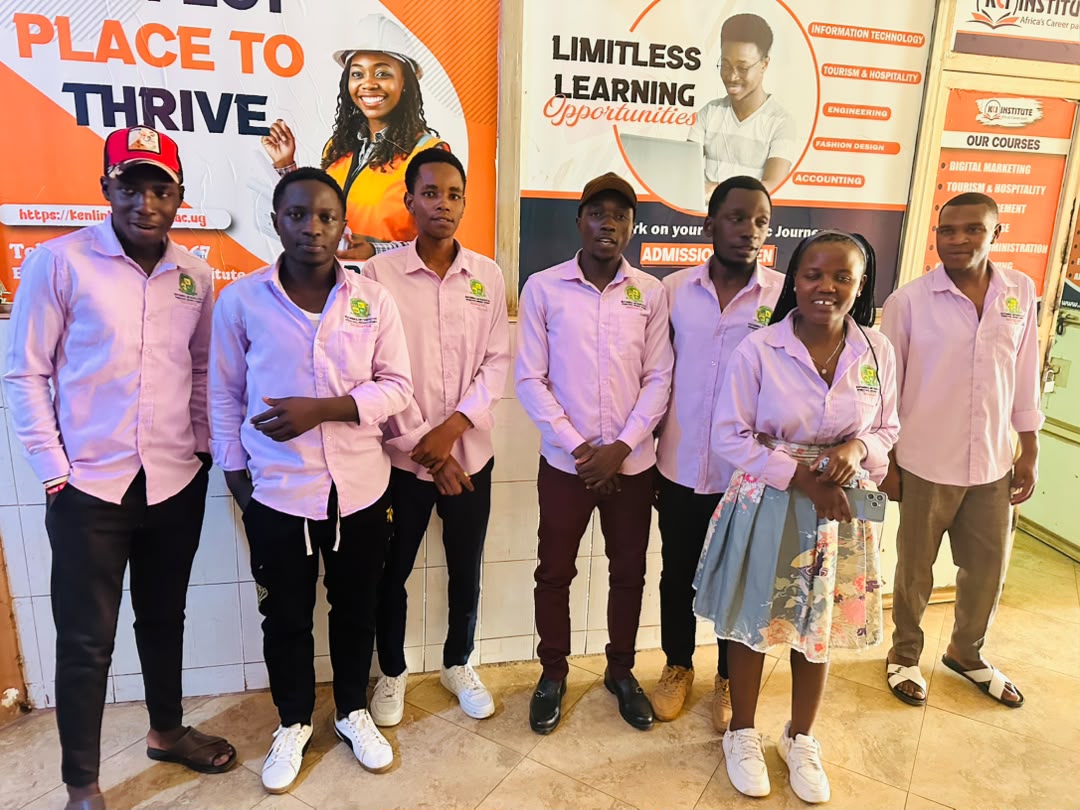
Best Practical Institute in Uganda
Best Practical Institute in Uganda. Finding the best practical institute in Uganda is about more than a good-looking certificate. It comes down to one simple question: when you finish the course, can you actually do the job? An employer will not ask how well you memorised a textbook. They will hand you the keys to an excavator, a group of visitors at a national park, a client’s hair, or a website that needs fixing, and then watch what you do.
At KCI Institute, this is the question we have built our training around since 2009. In this guide, we explain what “practical” should really mean, why it matters so much in today’s job market, how Uganda’s new laws are changing skills training, and how to compare institutes before you pay any fees. We also show you exactly what we offer, so you can judge for yourself whether KCI is the right place for you.
What Makes an Institute Truly Practical?
Almost every institute in Uganda now describes its courses as “hands-on”. The word is easy to print on a flyer, so it helps to know what it should look like in reality.
A practical institute gives you real time on real tools. You should spend a large share of your course operating the machine, serving the guest, cutting the fabric or writing the code, rather than watching someone else do it. Your trainers should be people who have worked in that trade and can correct your mistakes as you make them.
There is also an internationally recognised idea behind this. UNESCO-UNEVOC defines work-based learning as learning that happens in a real work environment, with apprenticeships, internships and on-the-job training as its most common forms. The International Labour Organization adds that countries are prioritising this approach because it can reduce skills mismatch and make the move from training into work smoother.
In simple terms, a strong practical institute does four things well:
- It teaches the skill by having you perform it repeatedly.
- It takes you out of the classroom and into the field or workplace.
- It uses trainers with real industry experience.
- It connects your training to a recognised assessment and to people who hire.
Why Practical Training Matters More Than Ever in Uganda
The numbers explain why so many families are rethinking the old “any certificate will do” approach.
According to reporting on the latest labour market report from the Uganda Bureau of Statistics, youth unemployment has climbed to 17.9% among people aged 15 to 24. The 2024 census paints an even wider picture, with 5.2 million young people aged 18 to 30, or 42%, not in employment, education or training.
One finding in that UBOS labour market report deserves special attention. Young people with post-primary specialised training and above recorded the highest unemployment rate, at 28.2%. That is a hard truth, and we would rather share it than hide it: a qualification alone does not guarantee work. What you can do with it, how well you can do it, and whether you can create your own income all matter a great deal.
That is why choosing training carefully is so important. Paying for a course that leaves you with a paper but little confidence on the job is an expensive mistake. Choosing one that builds skills employers can see, or that you can sell directly to customers, gives you a much stronger starting point.
More Ugandans seem to be reaching the same conclusion. The Uganda Vocational and Technical Assessment Board (UVTAB) recorded its highest-ever number of candidates, with more than 137,000 trainees sitting the November–December 2025 assessments.
How Uganda’s TVET Reforms Are Raising the Bar
If you are choosing a course in 2026, you are doing so under a new system. The Technical and Vocational Education and Training Act, 2025 came into force on 15 March 2025, and you can find it alongside the TVET Policy on the Ministry of Education and Sports policies page.
Here is what these reforms mean for you as a learner:
- One national assessment body. UVTAB was formed through the merger of the Uganda Business and Technical Examinations Board and the Directorate of Industrial Training. It is mandated to assess and certify TVET qualifications from level 1 to level 4.
- More focus on practical work. A Daily Monitor commentary describes a competence-based curriculum being rolled out with about 70% of training time for practical work and 30% for theory.
- Skills acquired informally can count. UVTAB assesses competences from both formal and non-formal training, so a person who learned a trade on the job may also be able to seek certification.
- Stricter rules for training providers. New assessment rules bar centres from operating without official UVTAB accreditation, while the TVET Council has also cautioned institutions about accreditation as it approves new programmes.
This is good news for serious learners. It rewards institutes that genuinely train people, and it gives you clearer questions to ask before you enrol.
Checklist: How to Choose the Best Practical Institute in Uganda
Before you pay at any institute, including ours, use this checklist. A good institute will be happy to answer every question.
- Ask to see its current licence or accreditation. Check whether it covers the specific course you want, and ask which body will assess you at the end.
- Ask how much of the course is practical. Request a rough number of hours, not just the word “hands-on”.
- Visit the training space. Look at the machines, kitchens, salons, computers or vehicles you will use. Are they in working condition? How many learners share each one?
- Meet the trainers. Ask where they worked before they started teaching.
- Find out about field trips and attachments. Who arranges them, and are they included in the fees?
- Get all the costs in writing. Include tuition, admission, assessment, uniforms, materials and any licence or permit fees.
- Talk to former students. Ask them what happened after they finished, not only whether they enjoyed the course.
- Be careful with big promises. Treat any guarantee of a job, or a very short route to a highly skilled trade, as something to verify.
If an institute avoids these questions, take that as a warning sign and keep looking.
Why KCI Institute Is a Strong Choice for Practical Training
So where do we stand? No official national ranking names a single “best” institute, so the fairest test is to look at what an institute actually does. Here is what we offer learners at KCI Institute. You can read more on our About Us page.
Practical training across our courses. We build practical work into every course, in the way each field requires. A tour guide trains differently from a welder, and the course should reflect that.
Learning in the field. We take students out to experience real field operations. Our tourism learners, for example, can explore tourism courses connected to Uganda’s national parks, so wildlife and visitor management become more than topics in a notebook.
Mentorship from professionals. Students receive guidance from people working in their fields, led by our principal, Mr Hafasha Keneth. Former student Mugisha Isaac, now a managing director, credits that mentorship for much of his growth.
Support as you move into work. Our team works to connect students with companies and organisations. You can also browse current openings on our job opportunities page. Like any honest institute, we cannot make the hiring decision for an employer. Your skills and attitude will always count.
Flexible study. Our application options include morning, afternoon, full-day, weekend and online sessions, which helps if you are already working or running a business.
A clear progression path. You can begin with a short skill course and, where it suits your goals, move on to one-year and two-year programmes.
Ankunda Pauline, now a tour consultant, took our tourism operations short course specifically because she wanted practical training, and she recommends the school for that reason. Stories like hers are why we keep the focus on doing. Before you decide, we encourage you to come and see a class for yourself, ask our trainers questions and compare what you find with the checklist above.
Practical Courses You Can Study at KCI Institute
We offer a wide range of options, from two-week skill courses to longer programmes. You can see the full list on our UVTAB courses page and our all courses page. Here is a quick overview, based on our published course information.
| Field | Example courses | Typical duration |
|---|---|---|
| Heavy machinery | Excavator, forklift, grader, bulldozer, tower crane | 2–8 weeks |
| Tourism and hospitality | Tour guiding and driving, tourism operations, air ticketing, hotel management | 2–5 months |
| Driving and mechanics | Defensive driving, driving and mechanics, automotive mechanics | 2 weeks–4 months |
| ICT and business | ICT and web design, digital marketing, business administration | 3–4 months |
| Beauty and fashion | Hairdressing, cosmetology, fashion and design | 3–5 months |
| Technical trades | Electrical installation, welding, hydraulic systems | 5 weeks–4 months |
| Languages | English, French, German | 3 months per level |
Longer one-year and two-year programmes are also available in areas such as ICT, tourism, human resource management, business administration and electrical installation.
Heavy Machinery Training With Real Career Potential
Uganda’s roads, construction sites, farms and industrial projects all depend on skilled operators. Our heavy machinery training covers more than 20 machines and technical trades. These include excavators, graders, bulldozers, front-end loaders, backhoes, forklifts, mobile and tower cranes, drill rigs, farm tractors, dump trucks, and trailers.
The programmes are short and focused. For Ugandan nationals, published fees include UGX 700,000 for a two-week forklift course and UGX 1,200,000 for a three-week excavator course. A 5-to-15-tonne mobile crane course costs UGX 1,700,000 and runs for five weeks. Please confirm current fees and schedules with our office before you plan your budget.
Because machine operation is high-risk work, safety should be central to any course you choose. Ask any training provider how much seat time you will get and whether the fee includes any licence or permit you will need for the job.
Tourism and Hospitality Training Built for the Field
Tourism remains one of the most exciting sectors for young people. According to the Daily Monitor, it directly employed 803,691 people in Uganda in 2023, making up 7.2% of national employment. Yet the same report asks a tough question: how many of those jobs become real careers? For us, the answer starts with graduates who can perform well from day one.
Our Tour Guiding and Driving Course runs for 16 weeks and combines two valuable skills. You cover off-road and defensive driving, vehicle maintenance, wildlife and cultural heritage, communication with visitors and first aid. If you want a shorter route, read our guides to the short course in tour guiding and tourism short courses in Uganda.
Not sure which role would suit you? Our overview of tourism careers in Uganda is a helpful place to start. Learners who prefer hotels and guest service can look at our tourism and hospitality management programme.
Driving, Mechanics and Technical Trades
Good drivers and mechanics are needed across logistics, public transport, tourism, NGOs and corporate fleets. Our driving training in Uganda includes manual and automatic options, as well as a two-week defensive driving course. If you want to do more than drive, a four-month combination of driving and mechanics gives you skills to look after the vehicle too.
For people who like building and fixing things, we also offer electrical installation, welding, boiler making, and petrol and diesel engine mechanics. These trades offer two useful routes: you can seek employment, or you can gradually build your own workshop and client base.
ICT, Digital Marketing and Business Skills
Every modern business needs someone who can manage a website, run a campaign or keep records in order. Our short courses in ICT and web design, computer skills and secretarial work, digital marketing and business administration are designed to give you skills you can put to use quickly. Those who want deeper knowledge can look at our longer ICT and business programmes.
The best way to learn these skills is by building something. Whichever institute you choose, aim to finish with evidence of your work, such as a simple website, a marketing campaign or a set of business documents. A portfolio can often say more to an employer or client than a transcript.
Beauty, Fashion and Other Self-Employment Skills
Hairdressing, cosmetology and fashion design have a major advantage: you can begin earning from a small space with a modest set of tools and a good reputation. Our hairdressing and salon management course and our cosmetology and fashion programmes are built around the craft itself. As you practise, it also pays to start thinking about customers, pricing and service, because these decide whether a skilled hand becomes a steady income.
These fields suit school leavers, parents returning to work and anyone looking for a second income. Since many graduates go on to work for themselves, it is worth learning basic business skills alongside your trade.
Language Courses That Open Doors
Language is also a practical skill, particularly in tourism, hospitality and international work. Our language courses in English, French and German have three levels each. Every level takes three months and costs UGX 500,000, and you can pay level by level or for the full course in advance.
For adult learners who feel nervous about starting, our article on English learning schools for adults in Uganda offers useful guidance. A tour guide who can speak French or German to visitors, for example, has a clear advantage over one who cannot.
Turning Your Skill Into a Business
Not every graduate wants an employer. Many want to become one. A skill becomes much more powerful when you know how to price it, market it and manage the money it brings in.
Our business consultation service supports aspiring entrepreneurs, small businesses and organisations with planning, financial management, marketing and growth. The published consultation fee is UGX 100,000, and you can book a consultant online. This is a natural next step for a graduate planning to open a salon, a tour company or a repair workshop.
How to Get the Most From Your Practical Course
Even the best institute cannot do the work for you. These habits will help you get full value from your fees:
- Attend every practical session. Missed practice is very hard to recover in a short course.
- Ask to repeat what you find hard. Your trainer would rather correct you now than see you struggle at work.
- Document your work. Keep photos, projects and notes for your CV and portfolio.
- Build relationships. Your trainers and classmates may become your first references, partners or customers.
- Keep learning after you finish. Machines, software and customer expectations keep changing.
How to Apply to KCI Institute
Our admission process is straightforward:
- Choose your course and submit your application. Use our online application form, which offers February, March/April, May/June and August/September intakes.
- Wait for the review. Our team reviews applications within two working days.
- Take a pre-entry test, if requested. This helps us check that the course matches you.
- Attend an interview. We will talk through your goals and help you settle on the right course.
- Receive your decision and begin. Then get ready to start training.
For short courses, bring any academic documents you have, your National ID or passport, two passport photos and the UGX 50,000 admission fee. Longer courses need your UCE or UACE documents. Heavy machinery courses have a few additional requirements, which are listed on that course page.
You will find us at Plot 149, Dolphin Plaza, Gayaza Road, Mulago Kubiri. You can also call +256 200 955 001 or +256 789 210 067, or email info@kenlinkinstitute.ac.ug.
Frequently Asked Questions
Here are the questions we hear most often from students and parents.
Which is the best practical institute in Uganda?
There is no official ranking, and the best choice depends on the skill you want. Look for current accreditation, plenty of hands-on time, experienced trainers, working equipment and honest evidence of graduate outcomes. KCI Institute offers practical training across tourism, heavy machinery, driving, ICT, beauty, technical trades and languages. We invite you to visit and compare us for yourself.
Can I join a practical course without UCE or UACE?
For our short courses, we ask for any academic documents you have, along with identification and passport photos. One- and two-year programmes require UCE or UACE documents. Contact our office with your specific situation.
How long does practical training take?
It depends on the skill. Our heavy machinery courses usually run for two to eight weeks, most other short courses take between two weeks and five months, and longer programmes take one to two years.
Will I get a job after finishing?
No honest institute can promise this for every student. We work to connect our students with employers and mentors, but your results will also depend on your skills, attitude and the market. Practical skills can give you another important option too: working for yourself.
Is vocational training only for people who did poorly at school?
Not at all. TVET Council chairperson Allen Kagina has called for every post-secondary graduate to have a practical skill as a way of tackling youth unemployment. A short course can also sit alongside a degree or diploma, adding a skill that helps you find work or start a business.
Start Building Your Practical Career Today
The best practical institute in Uganda for you is one that can honestly show you the tools, the trainers and the path from training to income. Use the checklist above, ask direct questions, and judge every institute by what it can demonstrate.
We would be glad to be part of your comparison. Visit us on Gayaza Road, see our training for yourself, and explore more guides on the KCI Institute blog. When you are ready to turn your skills into opportunities, apply to KCI Institute today.

