
How Long Does It Take to Learn Heavy Equipment Operation?
How Long Does It Take to Learn Heavy Equipment Operation? It is one of the first questions almost every prospective student asks when they walk through our doors or reach out to our admissions team — “How long will it take?” It is a practical question, and it deserves a practical answer. Whether you are a school leaver planning your next move, a working adult considering a career change, or a parent trying to understand what your child is getting into, knowing how long heavy equipment training takes is essential to making an informed decision.
The honest answer is that it depends on the machine and the program — but the encouraging news is that across the board, heavy equipment training at KCI Institute is significantly shorter than most people expect. In a matter of weeks, not years, you can go from a complete beginner to a certified, job-ready operator. This guide breaks down the training durations for every major program we offer and helps you understand what happens during that time — so you know exactly what you are signing up for.
Why Heavy Equipment Training Does Not Take as Long as You Might Think
Many people assume that learning to operate a bulldozer, excavator, or crane must take years of study — the way a university degree does. This assumption holds back thousands of Ugandans from pursuing one of the most rewarding and well-paying technical careers available in the country today.
The reality is that heavy equipment operation is a practical, skills-based discipline. Unlike academic programs that require years of theoretical study before any real-world application, vocational machinery training is designed from day one around doing. Students spend the majority of their time behind the controls of real machines, under the guidance of experienced instructors, building the kind of hands-on competence that employers value most.
The Uganda Vocational Training and Apprenticeship Board (UVTAB) recognises short-duration, intensive vocational programs as legitimate and valuable pathways into technical careers — and the construction industry has long confirmed that well-trained graduates of focused programs are among the most employment-ready professionals entering the job market. At our institute, we have built our programs around this reality, delivering maximum competence in minimum time without ever compromising on quality or safety.
Short Programs — Two Weeks
Some of our most focused programs can be completed in just two weeks. These are specialist courses targeting specific machines that, while highly practical, have a more contained operational skill set than larger, more complex equipment.
Forklift — Two weeks of training covering safe loading and unloading techniques, mast operation, load balancing, warehouse navigation, and pre-operation safety checks. Forklift operators are needed in warehouses, manufacturing facilities, construction supply yards, and logistics companies across Uganda.
Roller — Two weeks of training focused on compaction techniques, surface preparation, operational safety, and machine maintenance basics. Roller operators are in constant demand on road construction projects across the country.
Bobcat — Two weeks of practical training in skid steer loader operation, including material handling, grading, and confined-space maneuvering. Bobcat operators are valued on construction sites where precision and agility in tight spaces are essential.
Even at just two weeks, these programs are intensive and comprehensive. Students do not spend those two weeks in a classroom — they spend them on the equipment, building real, transferable skill under direct instructor supervision.
Standard Programs — Three to Four Weeks
The majority of our heavy equipment operation programs fall into the three to four week category. These are our most popular courses and cover the machines most commonly used on Uganda’s construction, mining, and agricultural sites.
Excavator — Three weeks. One of our most enrolled programs, excavator training covers machine familiarisation, hydraulic systems understanding, core digging and loading techniques, trench work, site safety, and basic maintenance. Graduates are among the most sought-after operators in Uganda’s construction sector.
Grader — Four weeks. Motor graders require a higher degree of precision than many other machines, which is why the program runs slightly longer. Students learn road profiling, slope grading, drainage cutting, and material spreading techniques.
Bulldozer — Three weeks of training in land clearing, earthmoving, pushing, and ripping techniques across different terrain types.
Front-End Loader — Three weeks covering loading, dumping, stockpile management, and safe operation on busy construction sites.
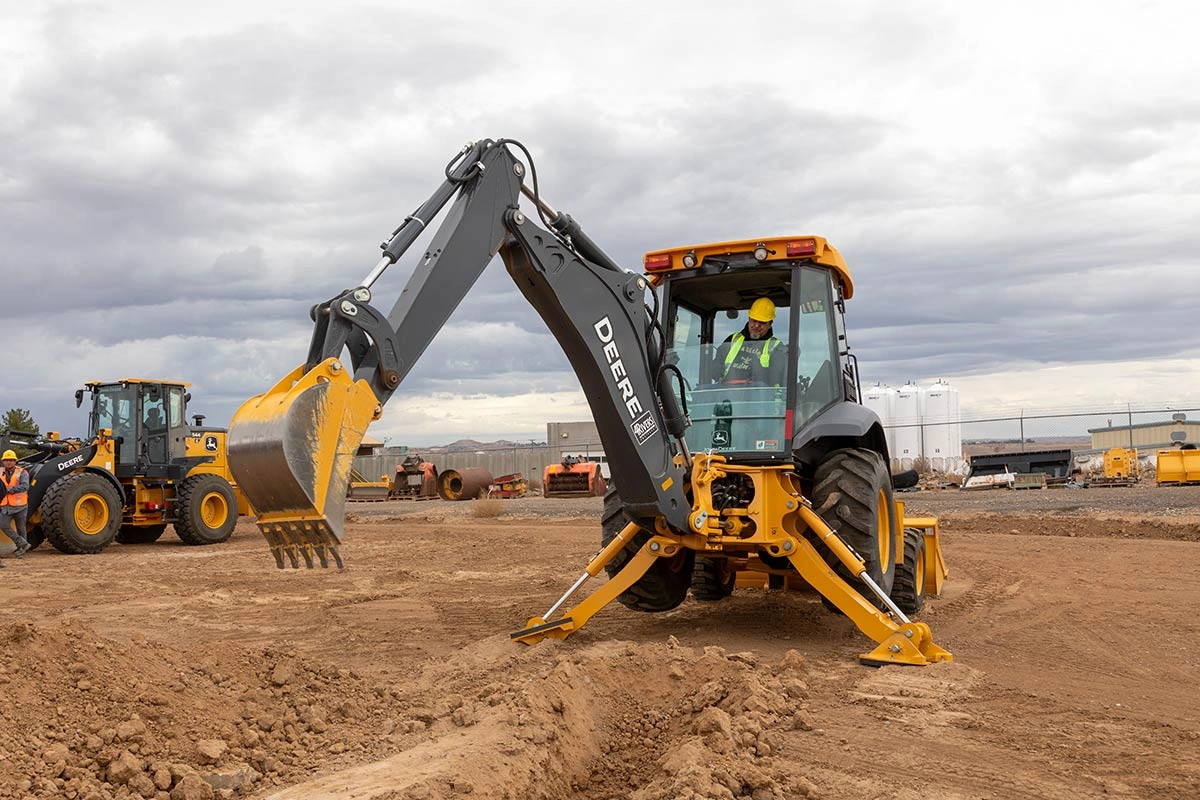
TLB / Backhoe — Three weeks. The TLB is a dual-function machine combining a front loader and a rear backhoe, making it one of the most versatile pieces of equipment on any site. Training covers both functions comprehensively.
Farm Tractor — Three weeks of training focused on agricultural applications including land preparation, tilling, ploughing, and equipment attachment operation.
Mixture Truck — Three weeks covering transit mix operation, drum management, concrete delivery procedures, and road safety for heavy vehicles.
Dump Truck — Three weeks of training in load management, tipping procedures, site navigation, and safe heavy vehicle operation.
Tipper — Three weeks of focused training on tipper body operation, load management, and site and road safety compliance.
Ten Tyre Truck — Three weeks covering multi-axle vehicle handling, load management, and road regulations for heavy transport vehicles.
Full details of all program fees for both Ugandan nationals and international students are clearly listed on our Heavy Machinery Training Page.
Intermediate Programs — Five to Six Weeks
Some of our programs require additional time to cover the greater complexity and responsibility involved in operating more specialised equipment.
Mobile Crane — 5 to 15 Tonnes — Five weeks of training covering lift planning, load charts, rigging principles, slinging techniques, and safe crane operation on construction sites. Crane operation demands exceptional precision and situational awareness, and our five-week program is designed to build both.
Mobile Crane — 25 to 50 Tonnes — Also five weeks, but covering the additional complexity and responsibility involved in operating significantly larger crane configurations. This program is suited to students who want to work on major infrastructure and industrial projects.
Drill Rig — Five weeks of specialist training covering drilling techniques, rig setup and breakdown, ground condition assessment, and safety protocols for drilling operations in construction and mining environments.
Welding — Five weeks covering core welding techniques, material preparation, joint types, equipment handling, and workplace safety. Welding is one of the most universally needed skills on any construction or industrial site.
Hydraulic Systems — Five weeks of in-depth technical training on the hydraulic systems that power most heavy construction equipment. This program is ideal for students pursuing a mechanical rather than operational career path.
Boiler Making — Four weeks covering fabrication techniques, metal cutting, shaping, and assembly — skills that are in consistent demand in construction, manufacturing, and industrial maintenance.
Tower Crane — Our tower crane program runs for six weeks, reflecting the significant level of technical skill, spatial awareness, and safety consciousness required to operate one of the most complex machines on any high-rise construction site.
Advanced Programs — Eight Weeks
Our longest programs are designed for students pursuing advanced technical and transport careers. Eight weeks gives enough time to build genuine depth of knowledge and skill in areas that require it most.
Petrol Engine Mechanics — Eight weeks of comprehensive mechanical training covering petrol engine components, fuel systems, ignition systems, cooling, lubrication, and fault diagnosis.
Diesel Engine Mechanics — Eight weeks covering diesel engine systems in depth, including fuel injection, turbocharging, cooling, and servicing procedures for the heavy equipment and transport vehicles that power Uganda’s economy.
Bus — Eight weeks of intensive training for aspiring professional bus drivers, covering passenger vehicle management, road safety regulations, route navigation, and responsible driving practices.
Sino Truck — Eight weeks covering heavy-duty truck operation, load management, and long-haul transport procedures.
Trailer — Eight weeks of training for articulated vehicle operation, including coupling and uncoupling procedures, cornering techniques, and compliance with Uganda’s heavy transport regulations.
The Directorate of Occupational Safety and Health (DOSH) sets clear safety standards that apply across all these operational categories, and our eight-week programs are structured to ensure graduates are fully compliant and safety-aware before they enter the workforce.
What Happens During Training — Making Every Week Count
Regardless of whether your program runs for two weeks or eight, every single day of training at our institute is purposeful. Mornings typically begin with theory sessions covering machine systems, safety procedures, and operational principles. Afternoons are dedicated to hands-on practical time on real equipment, where students apply what they have learned under close instructor supervision.
As the program progresses, students take on increasingly complex tasks with decreasing levels of direct supervision — building the independence and confidence that employers look for in a job-ready operator. By the final week of any program, our students are operating equipment with the kind of composure and technical accuracy that makes them immediately valuable on a worksite.
The National Curriculum Development Centre (NCDC) champions vocational training as a fast, practical, and nationally respected route into skilled employment — and our program structure fully reflects the quality standards that this framework demands.
The Best Time to Start Is Now
Uganda’s construction industry is not waiting. Projects are underway, machines are running, and employers are actively looking for certified operators to fill roles that the market simply cannot supply fast enough. Every week you spend undecided is a week someone else is training, certifying, and stepping into a career that could have been yours.
Whether you are looking at a two-week forklift course or an eight-week diesel mechanics program, we are ready to welcome you and guide you through every step of the journey. Explore our full range of programs and their durations on our Heavy Machinery Training Page, and when you are ready to commit, submit your application through our Application Page.

